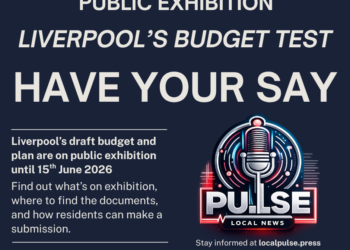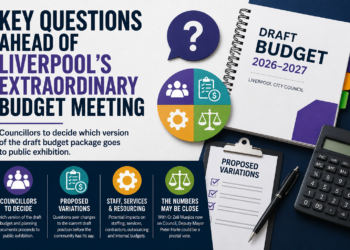







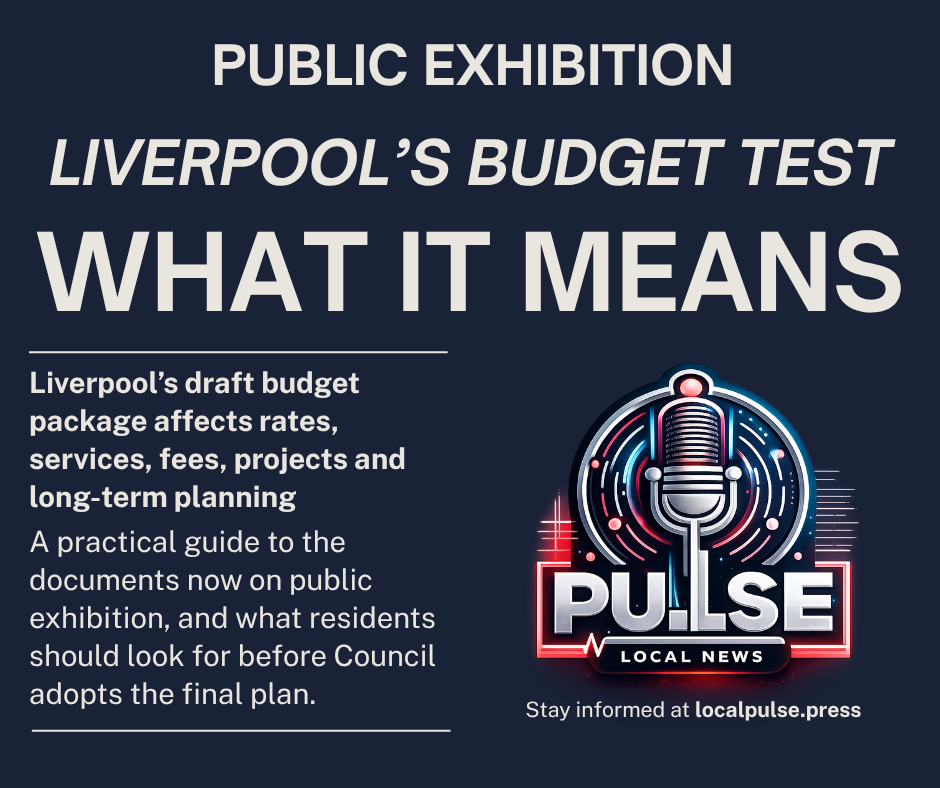

Liverpool Council’s draft planning and budget documents are now on public exhibition, setting out proposed rates, waste charges, service commitments, staffing assumptions, capital works and long-term financial settings for the year ahead.
Liverpool residents have until 15 June 2026 to comment on a major package of draft council documents that will help shape what households pay, what services are promised, and what projects Council says it can deliver in 2026-27.
The documents on exhibition include Council’s Draft Delivery Program 2025-2029 and Operational Plan 2026-2027, Draft Long-Term Financial Plan 2027-2036, Draft Revenue Pricing Policy (Fees and Charges) and the Liverpool Rating Category Map.
The package covers proposed spending, household charges, waste services, staffing, capital works and the assumptions behind Council’s long-term financial position.
Council’s exhibited Delivery Program and Operational Plan describe an operating budget of about $303 million and a capital works program of about $244 million for 2026-27.
The draft plan shows a capital works program that includes investment in roads, bridges, footpaths, land acquisition and improvements, drainage, floodplain management, parks, recreation and buildings.
For households, the effects are likely to show up through rates, bins, local services, fees, roads, parks and Council response times.
What is on exhibition?
The Draft Delivery Program sets out Council’s principal activities for 2025-2029, while the Draft Operational Plan is Council’s annual action plan for 2026-2027.
The Long-Term Financial Plan supports the Delivery Program and Operational Plan by outlining how Council plans to manage its resources, including capital works to be completed annually and over the long term.
The Revenue Pricing Policy (Fees and Charges) is also part of the Delivery Program and Operational Plan, but is published as a separate supporting document showing what residents, businesses, community groups and users of Council services may pay.
The Liverpool Rating Category Map shows the 2026-2027 rating category and subcategories applicable across the LGA.
Council’s public exhibition page lists the exhibition period as 19 May to 15 June 2026.
Residents can read the draft documents and follow the submission instructions through Liverpool Council’s Public Exhibitions and Notices page.
These documents are still drafts. They are not the final adopted budget.
Residents are being asked to respond before the package becomes Council’s final operating plan for the next financial year.
What households may notice first
The most immediate part of the draft package is cost.
The draft Long-Term Financial Plan says Council’s 2026-27 budget incorporates a 4.1% rate variation, made up of a 3% general increase and a 1.1% population growth factor, in line with the IPART determination.
The draft documents also show an increase in the Domestic Waste Management charge.
The Draft Revenue Pricing Policy (Fees and Charges) lists the annual Domestic Waste Management charge moving from $670 to $735, an increase of $65, or 9.7%.
There are also proposed changes to a range of fees and charges, including some costs connected to parking, road occupancy, planning, engineering, recreation, venues and waste services.
Most households will not see the budget through one number.
The impact will depend on rates, the standard waste charge, local services and any Council facilities or fees a household uses.
Council should make the combined household impact clear before adoption.
Waste, bins and basic services
Waste services are likely to draw close attention because they are among the Council services residents see most directly.
Bins, bulky waste, illegal dumping, street presentation and basic neighbourhood maintenance all affect how people judge whether Council is keeping up with the city’s needs.
The exhibited draft package points to two main household waste-service changes.
The first is an expansion of the existing booked household clean-up system from two to four booked household clean-ups per year.
The second is expanded eligibility for red-lid garbage-bin upgrades.
The budget papers specify that the red-bin upgrade eligibility threshold would be reduced from six family members to five family members per household. Qualifying households can receive either two 140L red-lid garbage bins or one 240L red-lid garbage bin.
The draft plan attributes the $65 increase in the standard annual Domestic Waste Management charge to contractor pricing, CPI adjustment, increased household clean-up service and red-bin upgrades.
The delivery test is whether the higher charge leads to shorter waits, clearer eligibility and more reliable waste services.
Council should explain how it will manage extra clean-up demand, meet the proposed service standard, promote red-bin eligibility and report the results.
Service commitments and accountability
The draft documents also set out service commitments and performance measures.
The Draft Delivery Program and Operational Plan are intended to translate community priorities into annual actions, budgets and performance measures. The spending figures need to be read against those service commitments.
The questions are direct:
- What services are expected to improve?
- What will be measured?
- How will Council report progress?
- Which suburbs and facilities benefit from capital works?
- What happens if staffing, grant funding, property income or other assumptions change?
The missing detail is what the spending is expected to change.
Staffing and service delivery
Service improvements may depend on staffing.
Council’s ability to improve services may depend on whether it can fill vacancies, stage recruitment successfully and put enough staff into the areas where residents expect visible improvements.
If the budget assumes additional or filled positions in operations, compliance, parks, customer service or other frontline areas, residents should be told what those roles are expected to achieve.
Funded positions matter only if they translate into service results.
The service impact is the test: faster response times, cleaner streets, better maintained parks, improved compliance, clearer communication and fewer unresolved customer requests.
Capital works: where the money goes
Council’s draft plan points to a large capital works program, with major spending areas including roads, bridges, footpaths, land acquisition and improvements, drainage, floodplain works, parks, recreation and buildings.
The capital works figure needs to be read project by project.
Some projects may be ready for construction in 2026-27. Others may only be at the design or planning stage, or may depend on grants and future funding before residents see work on the ground.
Residents checking the capital works program should look for what is planned near them, whether it is funded for delivery in 2026-27, and whether it depends on grants or later decisions.
The long-term financial plan
The Long-Term Financial Plan sets out Council’s 10-year financial assumptions.
It deals with projected income, expenses, capital spending, cash reserves, debt, financial ratios and future assumptions.
The LTFP describes itself as a decision-making tool to help Council understand the financial impacts of strategic choices about services. It includes projected income and expenditure, planning assumptions, sensitivity analysis, financial modelling and major capital and operational expenditure implications.
The LTFP is where those assumptions appear: revenue, expenses, capital spending, cash reserves, debt and financial ratios.
It also shows the pressures behind the annual budget, including revenue, staffing, grants, property income, debt, capital works and service demand.
What still needs clearer explanation
Several points still need clearer public explanation before adoption.
The first is household impact: how rates, the standard waste charge and common fees combine.
The second is delivery: how the expanded clean-up service and red-bin upgrades will be delivered and measured.
The third is staffing: which roles are needed for service improvements and what happens if recruitment is delayed.
Council property and debt also sit within the broader financial picture. Liverpool Civic Place, Council-owned properties, rental income and asset optimisation should be explained clearly where they affect the long-term financial plan.
Residents also need to understand the main risks in the financial assumptions.
If revenue, costs, staffing, grants, property income or demand change, residents should be able to see how Council would respond.
Why submissions matter
The documents are on public exhibition, so residents still have an opportunity to respond.
Residents who want to read the draft documents or comment on the package can follow the submission instructions through Liverpool Council’s Public Exhibitions and Notices page.
A useful submission does not need to be long or technical.
It can focus on specific questions:
- Which service improvement matters most?
- Is the proposed waste charge justified by the service changes?
- Is a local road, park, drainage issue or community facility missing?
- Should Council provide clearer reporting on staffing, customer requests, waste, maintenance or capital works?
- Should Council provide clearer information on Civic Place, property income and debt?
The documents are dense. The public test is simpler.
Before adoption, residents should be able to see what they may pay, what services are expected to improve, which projects are funded, and what assumptions carry risk.
Source note: This article is based on Liverpool City Council’s public exhibition material for the Draft Delivery Program 2025-2029, Draft Operational Plan 2026-2027, Long-Term Financial Plan 2027-2036, Draft Revenue Pricing Policy (Fees and Charges), Liverpool Rating Category Map, and related 18 May 2026 Council budget report material.