






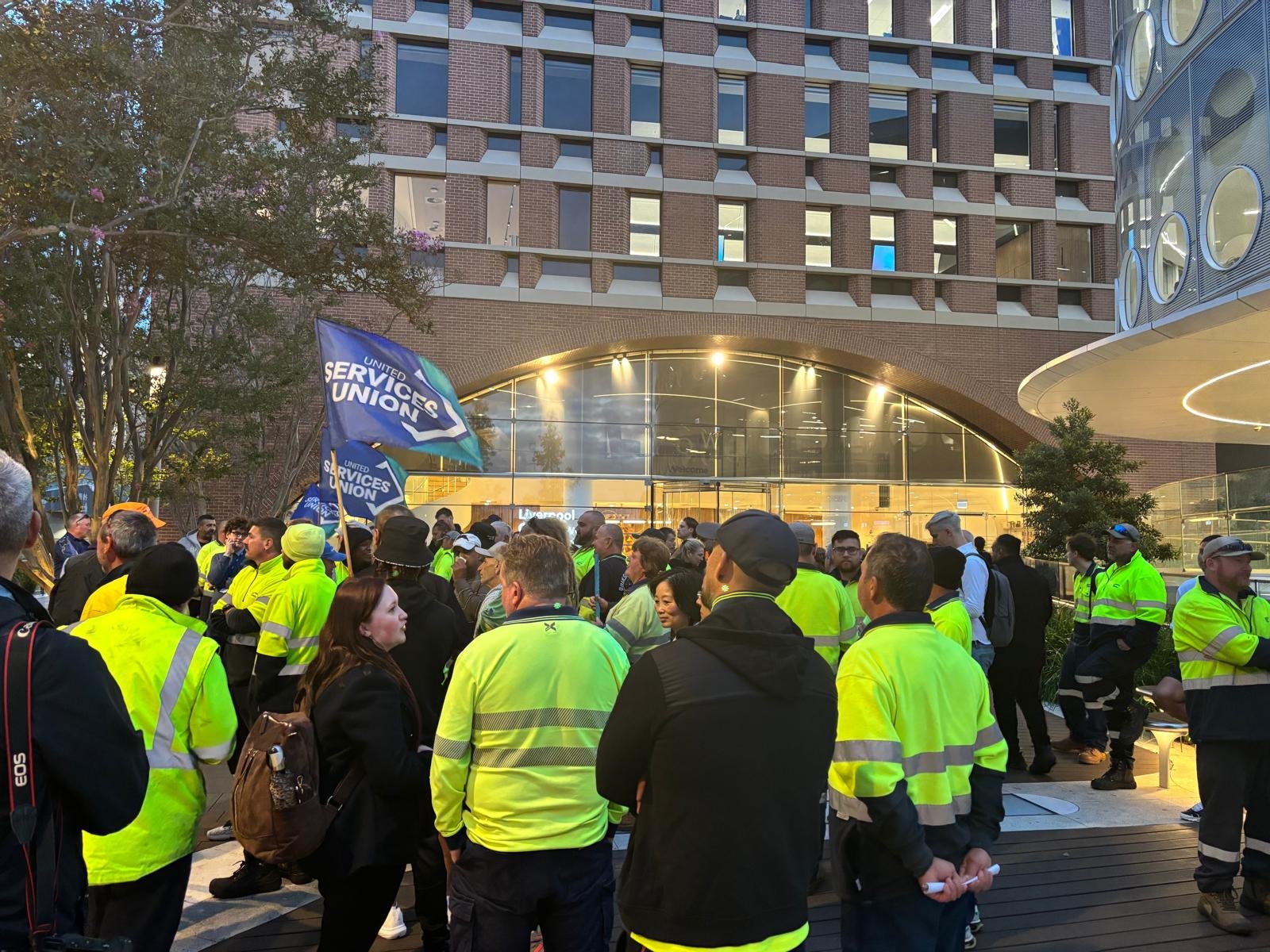

Liverpool Council’s extraordinary budget meeting has ended with a substantially revised motion, but the workforce concern that brought staff, union representatives and residents into the chamber has not disappeared.
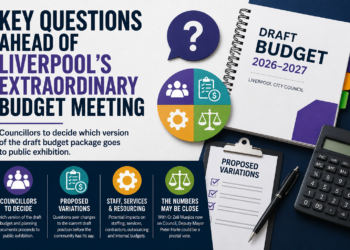
The meeting, held on Tuesday 12 May, had been called to consider changes to Council’s draft Delivery Program, Operational Plan, Long-Term Financial Plan and fees and charges.
But before councillors entered the chamber, the meeting had already become the centre of intense public attention after an earlier proposal circulated in confidential papers raised concerns about possible impacts on Council jobs, staffing levels and frontline services.
The United Services Union had rallied outside Liverpool Civic Place before the meeting, warning that staff jobs and services could be affected.
That earlier proposal was not the motion that ultimately passed.
After an attempt to move the matter into closed session was defeated, councillors debated the issue in open session. A 15-minute recess was later called so councillors could review revised wording.
The final motion shifted away from directly adopting the earlier proposal and instead required further modelling and scenario analysis from the Chief Executive Officer before the budget documents proceed through the next stages.
That distinction is important. The most controversial version of the proposal did not proceed.
But staff perspectives put to Local Pulse suggest Tuesday night’s outcome should not be read simply as a win or a political backflip. While the immediate motion changed, the broader concern remains: another episode in a long and familiar fight over job security, workforce stability and the pressure placed on long-serving Council employees.
For long-serving workers, the events of this week have again reinforced a broader workplace concern: that careers and livelihoods can be placed under threat with limited warning, even while staff are expected to continue delivering the services residents rely on.
Harle says budget debate belonged in public view
Deputy Mayor Peter Harle, an independent councillor whose vote was closely watched before the meeting, told Local Pulse Press he believed budget matters should be dealt with transparently.
“I believe Budget matters should be transparent, viewable by the public, and should have been easily discussed without involving employees, as they eventually were,” Cr Harle said.
He said the original motion, as published in the confidential papers and leaked to the media, “was never going to be supported by most Councillors including me.”
Cr Harle also said he had raised concerns before the meeting about the legality of the original motion, including whether staffing decisions could properly be dealt with in the way proposed.
His response suggests the decisive shift in the meeting was not simply a last-minute change in the chamber, but that opposition to the earlier wording had already formed before councillors sat down to debate it publicly.
Ristevski: public scrutiny changed the outcome
Councillor Peter Ristevski also told Local Pulse Press he did not support moving the budget matter into closed session.
“I did not support attempts to hide major budget discussions from the public,” Cr Ristevski said.
“Ratepayers deserve transparency, especially when discussions involve staffing, frontline services, and the future direction of Council spending.”
Asked whether keeping the matter in open session changed how the motion was handled, Cr Ristevski said it did.
“Absolutely. Public scrutiny matters,” he said.
“Once the debate remained in open session, there was significantly greater accountability and greater caution around how the proposal was framed and presented. Sunshine is the best disinfectant.”
Cr Ristevski said he had concerns about any earlier proposal that could weaken frontline services, particularly parks maintenance, cleaning, sportsfields and operational services.
“Residents already feel frustrated about deteriorating maintenance standards across Liverpool,” he said.
“The last thing ratepayers want is less accountability and more outsourcing experiments that end up costing more long term.”
Confidentiality questioned in the chamber
During debate, Labor councillor Ethan Monaghan challenged the basis for treating the matter as confidential.
“It is simply not a confidential document,” Cr Monaghan said during the meeting.
“It does not attract the confidentiality provisions of this Act. The Office of Local Government has had a number of things to say about this as well.”
Cr Monaghan also linked the debate to broader concerns recently examined through the Liverpool City Council Public Inquiry, including councillors being asked to deal with substantial matters at short notice and then debate them behind closed doors.
He argued this was not the type of matter that should be removed from public view.
At one point, Mayor Ned Mannoun called Cr Monaghan to order after comments were made about the person behind the proposal, on the basis that they were personal reflections.
What actually changed
The meeting appears to have moved through several stages.
First, councillors were presented with an earlier budget proposal in confidential papers. That proposal triggered concern from staff, the United Services Union and members of the public before the meeting.
Second, Council considered whether the matter should be moved into closed session. That attempt failed.
Third, councillors debated the issue in open session, with criticism raised about the process, the confidentiality claim and the substance of the earlier proposal.
Fourth, a recess was called so councillors could consider revised wording.
Finally, Council passed a different motion focused on further budget modelling and scenario analysis, rather than directly implementing the earlier workforce-related proposal.
That change matters. It means the proposal that triggered the strongest public concern was not adopted in its original form.
But the result does not resolve the underlying workforce issue.
The concern now is what options will be modelled, what assumptions will sit behind those options, and whether staffing, vacancies, outsourcing or service reductions could re-emerge through the formal budget process.
Not simply a win
The events of Tuesday night can be read in more than one way.
Politically, the meeting saw a controversial proposal softened after public scrutiny, union pressure and open debate.
Procedurally, it raised questions about why a significant budget proposal involving potential workforce implications was initially placed in confidential papers, and whether councillors and the public were given enough time and information to properly assess it.
For staff, however, the issue is more personal and more familiar.
The concern is not only whether one motion changed on one night. It is whether Council workers are again being asked to operate under uncertainty about their future while continuing to deliver essential local services across Liverpool.
That includes the services residents notice every day: roads, parks, footpaths, waste, libraries, cleaning, maintenance, compliance and customer service.
The revised motion may have changed the immediate outcome, but it has not ended the broader argument over Council’s workforce, service levels and the stability of the people expected to keep Liverpool running.
The fight shifts back into the budget process
Council’s draft budget documents are expected to continue through the formal budget process, including further modelling, documentation and public exhibition before final adoption.
For councillors, the next test will be whether future budget options are presented clearly, publicly and with enough time for proper scrutiny.
For residents, the question is whether the final budget will improve services across the Liverpool local government area.
For staff, the issue remains job security, respect and certainty.
Tuesday night may have stopped one version of the proposal. It did not end the broader fight over the future of Council’s workforce.