






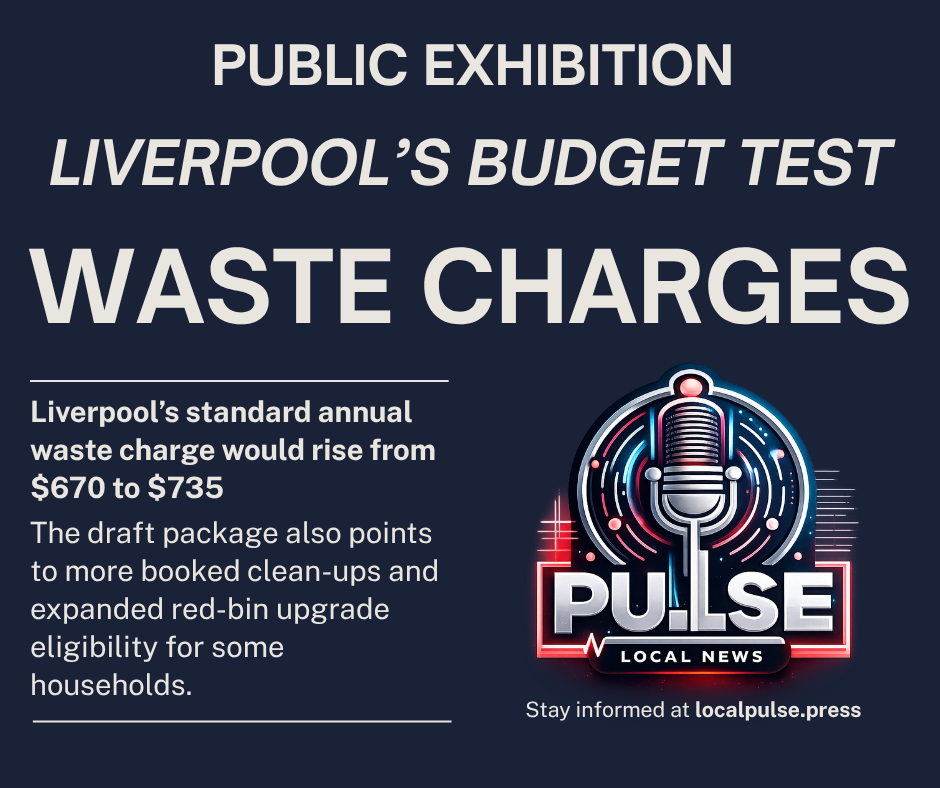

Liverpool Council’s draft budget proposes a higher waste charge, with the exhibited documents pointing to four booked household clean-ups per year and expanded red-bin upgrade eligibility as the key waste-service changes residents are being asked to consider.
Waste is one of the easiest parts of Council’s draft budget for residents to judge.
Most households may not read every page of a long-term financial plan, but they know when bins are overflowing, bulky waste is sitting on the kerb, illegal dumping appears nearby, or street presentation starts to slip.
For Liverpool Council’s draft 2026-27 budget, the waste charge creates a direct test: if households are asked to pay more, what service improvement will they see?
The exhibited Draft Revenue Pricing Policy (Fees and Charges) shows the standard annual Domestic Waste Management charge increasing from $670 to $735. The change is a $65 increase, or 9.7%.
Council’s draft material attributes the increase to contractor pricing, CPI adjustment, increased household clean-up service and red-bin upgrades.
The exhibited documents link the higher charge to extra household clean-ups and expanded red-bin eligibility.
What is in the exhibited waste package?
The current exhibition package points to two main household waste-service changes.
The first is an increase from two to four booked household clean-ups per year.
The second is expanded eligibility for red-bin upgrades.
Council is presenting the increase as part of a service improvement package, not simply as a higher charge.
For households that regularly use bulky waste collections, four booked clean-ups a year may be a noticeable improvement.
For larger households, or households with higher general waste needs, expanded red-bin upgrade eligibility may also matter.
Both changes depend on delivery.
The unresolved issues are whether extra capacity will reduce wait times, whether the two-week service standard can be met, and how newly eligible red-bin households will be told about the option.
Four booked clean-ups per year
The 18 May budget report said bulk household waste collections are currently managed in-house by Council.
The proposal is to increase the service from two to four booked household clean-ups per year.
The material points to an expansion of the existing booked household clean-up model, rather than a move to a separate scheduled kerbside collection system.
Council used a baseline of 4,419 collections per month to model the additional collection, disposal and resourcing costs. The report estimated the base annual cost of the service at $8.9 million excluding GST.
The 18 May report said the Long-Term Financial Plan currently adopts a 25% uptake scenario as the most likely outcome. On that basis, the expanded service was modelled at $11.1 million excluding GST, with an incremental cost of about $2.2 million.
The report also modelled a 50% uptake scenario at $13.3 million excluding GST.
The draft package proposes four booked household clean-ups per year instead of two.
The change may be useful, but only if the extra capacity translates into faster and more reliable booked clean-ups.
The two-week service question
The exhibited Draft Operational Plan refers to four household clean-ups per year with a maximum two-week service agreement.
The 18 May budget report also referred to current collection lead times of four to six weeks when modelling the expanded service.
Council should explain clearly how the expanded booked clean-up model will move from those current lead times to the proposed maximum two-week service standard.
The booked clean-up process already exists. The budget issue is whether Council can reliably deliver the expanded entitlement within the proposed two-week service standard.
Without that detail, residents may see the higher waste charge before they see the better service.
Red-bin upgrades: who would be eligible?
The red-bin upgrade change is aimed at larger households.
The 18 May report said the eligibility threshold for an additional general waste bin would be reduced from six family members to five family members per household.
Qualifying households could receive either two 140L red-lid garbage bins or one 240L red-lid garbage bin.
Under the current criteria, the report said 5,849 households are eligible for the service. The proposed change would increase that number to 7,795 households.
The report also said current uptake is 18% of eligible households, noting the option has had limited promotion to residents.
Current uptake matters because Council’s report says the option has had limited promotion.
If many eligible households do not know the service exists, expanded eligibility will only help residents if Council clearly promotes the option to newly eligible households.
The red-bin upgrade process already exists. The budget issue is how newly eligible households will be informed and whether higher uptake has been properly allowed for.
Higher uptake could also affect collection volumes, tipping costs and future waste-service costs, so Council should explain what assumptions sit behind the proposed change.
Why waste services matter
Waste services are one of the clearest tests of whether Council is delivering the basics.
Waste service is more than weekly bin collection.
It also affects street cleanliness, neighbourhood presentation, illegal dumping, pest control, local amenity and resident confidence that Council is keeping up with growth.
Liverpool’s population is growing, and different parts of the city face different waste pressures.
Established suburbs may have issues with illegal dumping, kerbside waste and ageing infrastructure.
Growth areas may face more pressure from new households, construction activity and changing service demand.
High-density areas may face different challenges again, including bin-room capacity, collection access and dumped material around shared spaces.
Council’s explanation needs to connect the higher charge with collection capacity, wait times, red-bin uptake and measurable street-level results.
The $65 test
The exhibited documents show the standard annual Domestic Waste Management charge increasing by $65.
The issue is whether the increase is clearly connected to better service.
Before adoption, Council should provide a plain-English explanation of the waste package.
That explanation should include:
- what the $65 increase in the standard annual Domestic Waste Management charge pays for;
- how Council will meet the maximum two-week service agreement;
- whether the budgeted resourcing is enough if uptake is higher than modelled;
- how households that newly qualify for red-bin upgrades will be informed;
- whether higher red-bin uptake has been properly allowed for;
- how Council will measure whether illegal dumping and street presentation improve; and
- how residents will be able to track whether the higher charge has delivered a better service.
The existing process is already familiar to many residents. The budget issue is whether the proposed expansion delivers more capacity, shorter waits and measurable improvement.
The draft budget papers contain the broad settings. The unresolved issue is delivery.
Have your say
The draft budget package is on public exhibition until 15 June 2026.
Residents can read the documents and make a submission through Liverpool Council’s Public Exhibitions and Notices page.
For waste services, the question remains: if households are being asked to pay more, will they receive a clearer, cleaner and more reliable service in return?
That is the better-basics test for the draft waste package.
Source note: This article is based on Liverpool City Council’s public exhibition material for the Draft Delivery Program 2025-2029, Draft Operational Plan 2026-2027, Draft Revenue Pricing Policy (Fees and Charges), Long-Term Financial Plan 2027-2036, and related 18 May 2026 Council budget report material.