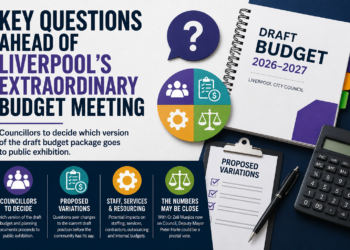






Liverpool residents have until 15 June 2026 to respond to Council’s draft budget package before the final documents are considered.
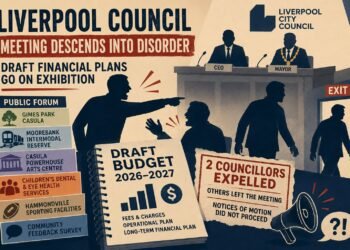
Liverpool City Council’s draft planning and budget documents are now on public exhibition.
The documents cover Council’s activities and annual actions, the budget for services and projects, what residents and service users may pay, how Council expects to manage its finances over the longer term, and which rating categories apply across the LGA.
The public exhibition period gives residents an opportunity to put their views on the record before the final documents are adopted.
The main exhibition materials include:
- Draft Delivery Program 2025-2029;
- Draft Operational Plan 2026-2027;
- Long-Term Financial Plan 2027-2036;
- Draft Revenue Pricing Policy (Fees and Charges);
- Liverpool Rating Category Map.
Council lists the exhibition period as 19 May to 15 June 2026. Residents can read the documents and make a submission through Liverpool Council’s Public Exhibitions and Notices page.
Why this matters
These documents affect rates, waste charges, fees, services, local projects and Council’s long-term financial position. They also affect Council service levels, local roads and footpaths, parks, community facilities, staffing assumptions and the fees paid by service users.
Residents do not need to read every page to make a useful submission.
A submission can focus on one issue, one suburb, one service, one fee, one local project or one question Council should answer before the final plan is adopted.
A useful submission is clear about what you support, what concerns you, and what you want Council to explain or change.
What to look for in the documents
The draft package covers a wide range of issues. Residents can focus on the areas that affect them most.
Household costs
The draft documents include a 4.1% rates income increase and an increase in the standard annual Domestic Waste Management charge from $670 to $735.
Residents may also be affected by changes to Council fees and charges, depending on the services they use.
A useful submission could ask Council to clearly explain the combined household impact of the rates settings, the standard annual waste charge and common fees.
Waste services
The draft package includes changes to waste services, including four booked household clean-ups per year and expanded red-bin upgrade eligibility.
Residents may want to ask how Council will meet the proposed maximum two-week service standard once the booked clean-up entitlement expands.
Residents may also want Council to explain how newly eligible red-bin households will be informed and whether higher uptake has been allowed for.
Local capital works
Council’s capital works program includes spending on roads, bridges, footpaths, drainage, floodplain works, parks, recreation and buildings.
Residents should look for what is actually planned in their suburb, near their home, or around facilities they use.
A useful submission could ask whether a project is fully funded for delivery, only funded for design, dependent on grants, or scheduled for a later year.
Parks, maintenance and basic services
Many residents judge Council by visible basics: parks, mowing, footpaths, roads, drainage, waste, illegal dumping, customer requests and local maintenance.
A submission can ask what service standards Council will use, how they will be measured, and how residents will know whether service levels have improved.
Staffing and service delivery
Some service improvements may depend on filling vacancies or staging recruitment during the year.
Residents can ask which roles are being filled, which services are expected to improve, and what happens if recruitment takes longer than expected.
Fees and charges
The Draft Revenue Pricing Policy (Fees and Charges) document affects more than rates and waste.
It can affect venue hire, recreation programs, parking, road occupancy, planning, engineering, community facilities, sporting users, businesses and applicants dealing with Council.
Residents, clubs, community groups and businesses should check whether any fee changes affect them directly.
How to write a useful submission
A submission does not need to be long or technical. The strongest submissions usually do three things:
- identify the issue clearly;
- explain why it matters;
- ask Council to do something specific.
Examples
- I support increasing booked household clean-ups from two to four per year, but Council should clearly explain how the expanded service will meet the proposed maximum two-week service standard.
- Before adopting the final plan, Council should publish a clear and accessible household-cost summary showing the combined effect of proposed rates, the standard annual waste charge and common fees.
- Council should identify which capital works are planned for my suburb in 2026-27, which are fully funded for delivery, and which are only design or planning allocations.
- Council should explain how the proposed increase in the standard annual Domestic Waste Management charge will translate into visible service improvements for residents.
A submission can support part of the draft package, oppose part of it, or ask for changes and clarification. It does not have to respond to every document.
Questions residents may want to ask
These questions may help residents get started.
On household costs:
- What is the average combined household impact of the proposed rates settings, the standard waste charge increase and common fees?
- What does the $65 increase in the standard annual Domestic Waste Management charge pay for?
- Which fee increases are Council-discretionary, and which are statutory or externally set?
On waste services:
- How will Council meet the proposed maximum two-week service standard for expanded booked household clean-ups?
- What uptake level has Council budgeted for the expanded clean-up service?
- What happens if uptake is higher than modelled?
- How will newly eligible red-bin households be told about the service?
- Has higher red-bin uptake been allowed for in the budget?
- How will Council track whether the red-bin change is being used?
On local works:
- Which projects are planned for my suburb?
- Which projects are fully funded for construction in 2026-27?
- Which projects depend on grants, future funding or later decisions?
- Are any local roads, footpaths, drainage issues, parks or facilities missing from the plan?
On staffing and service delivery:
- Which service improvements depend on filling vacancies?
- Which frontline roles are being filled?
- How will Council measure whether response times, maintenance, waste, compliance or customer service improve?
On long-term financial risks:
- What assumptions matter most in the Long-Term Financial Plan?
- What happens if revenue, costs, grants, staffing, property income or service demand change?
- How will Council report risks to the community during the year?
Keep it practical
A submission is more useful when it is specific.
Instead of only saying “fix the roads,” name the road, footpath, intersection or area.
Instead of only saying “waste is bad,” explain whether the concern is waiting times, illegal dumping, overflowing bins, lack of information or street presentation.
Instead of only saying “rates are too high,” ask Council to explain what residents may pay, what services are expected to improve, and how those improvements will be measured.
A short, specific submission is better than a long, general one.
Have your say
The public exhibition period runs from 19 May to 15 June 2026.
Residents can read the draft documents and make a submission through Liverpool Council’s Public Exhibitions and Notices page.
Council still needs to consider submissions before adopting the final documents.
Before that happens, residents have an opportunity to tell Council what they support, what concerns them, what needs to be clarified, and what should be changed before the final plan is adopted.
Sources: Liverpool City Council Public Exhibitions and Notices page; Draft Delivery Program 2025-2029; Draft Operational Plan 2026-2027; Long-Term Financial Plan 2027-2036; Draft Revenue Pricing Policy (Fees and Charges); Liverpool Rating Category Map; and 18 May 2026 CORP 05 addendum report.