


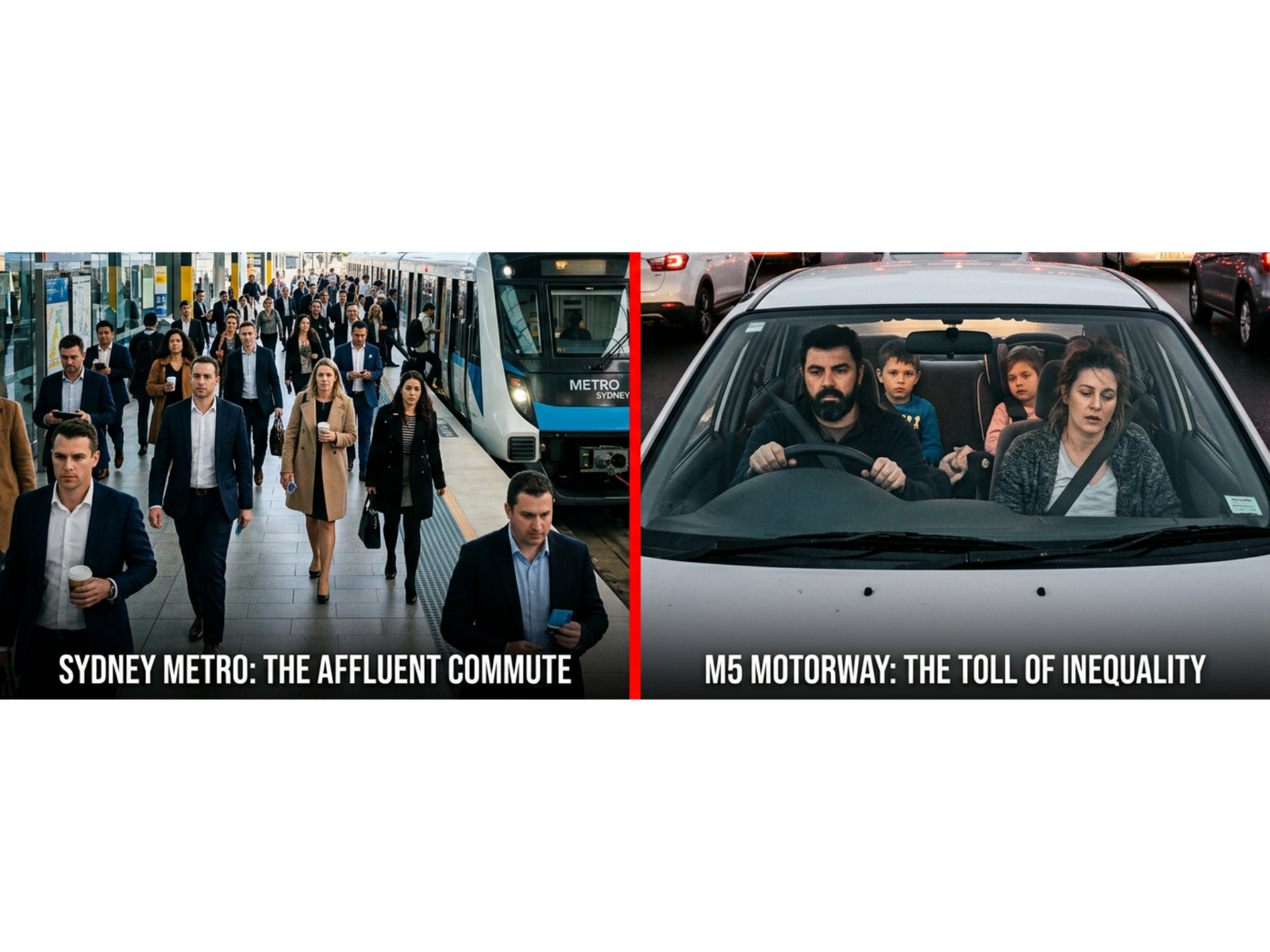

In Sydney, inequality is often discussed in abstract terms — housing stress, wage stagnation, cost-of-living pressure. But in the South West, it is lived in a far more practical way: at the petrol bowser, on the motorway, and in the hours families lose each week simply getting to work.
For people living closer to the city, transport is increasingly a matter of choice. There are metro lines, train connections and alternative ways to move around without relying on a car. For many families in South West Sydney, there is no such flexibility. Driving is not a convenience. It is a necessity.
That reality comes with a price. Households in the South West tend to rely on more cars, spend longer commuting, and face fewer viable public transport alternatives. When fuel prices surge, the impact is immediate. When tolls are added on top, the financial pressure stops being incidental and becomes structural.
That is why the continued tolling of the M5 South-West is not just frustrating — it is indefensible.
For many motorists, the M5 is the most direct and practical route available. Using it every weekday means paying $5.95 each way, or close to $60 a week for a regular return commuter. For Class B heavy vehicles, the charge is $17.85 each way. And from 1 April, those tolls will increase again to $5.98 for cars and $17.93 for trucks.
For families already stretched by rent, mortgage repayments, groceries, insurance and fuel, this is not a marginal expense. It is a recurring penalty attached to daily life. Businesses in the South West carry it too, particularly those operating heavy vehicles, delivery fleets or service runs across the metropolitan area. These costs do not disappear. They are absorbed, passed on, or painfully cut from somewhere else.
The injustice is sharpened by the fact that this toll was supposed to end years ago. The M5 toll was originally due to expire in 2014. Instead, it was extended — first to 2022, and then again to December 2026. The road itself has long since been paid off. Yet motorists in the South West are still being charged to use it.
That continuation is not an accident of history. It is a policy choice.
Each extension has sent the same message to South West Sydney: keep paying.
This is what makes the politics of toll relief so unsatisfying. During the election, Chris Minns promised to tackle “tollmania”. In office, his government introduced a weekly toll cap. That may offer some relief, and for frequent toll users it matters. But a cap is not abolition. It does not remove the burden; it merely places a ceiling on it. And it does nothing to answer the central question: why are South West motorists still paying at all for a road that should by now be free?
Nor is this only about tolls. It is about the geography of fairness in Sydney.
People in the city and inner suburbs are more likely to benefit from dense public transport networks, shorter travel times and a growing range of alternatives to driving. In the South West, many residents have no equivalent fallback. They cannot simply swap the car for a metro line that does not exist near their home, or avoid the motorway without adding significant time to an already long day. For them, the M5 is not a luxury route. It is part of the price of participation in the economy.
That is why the toll lands differently here. It is not merely a user charge. It is a burden imposed most heavily on those with the fewest practical alternatives.
The government could change that. It owns the asset. It has the power to remove the toll. Yet it continues to leave it in place while talking broadly about cost-of-living relief. That disconnect is becoming harder to defend.
Because if governments are serious about easing pressure on working families, they should start with the costs people cannot avoid. And for many in South West Sydney, the M5 toll is exactly that: unavoidable.
A city cannot claim to be serious about equity while asking one region to keep paying for infrastructure that should already be free, particularly when those same communities have fewer transport options to begin with. That is not balanced policy. It is unequal treatment dressed up as transport funding.
South West Sydney does not need another explanation of why the toll remains. It needs a government willing to end it.
Until that happens, every promise of cost-of-living relief will sound partial, and every claim of fairness will ring hollow.
The road is paid off. The excuse is not.