






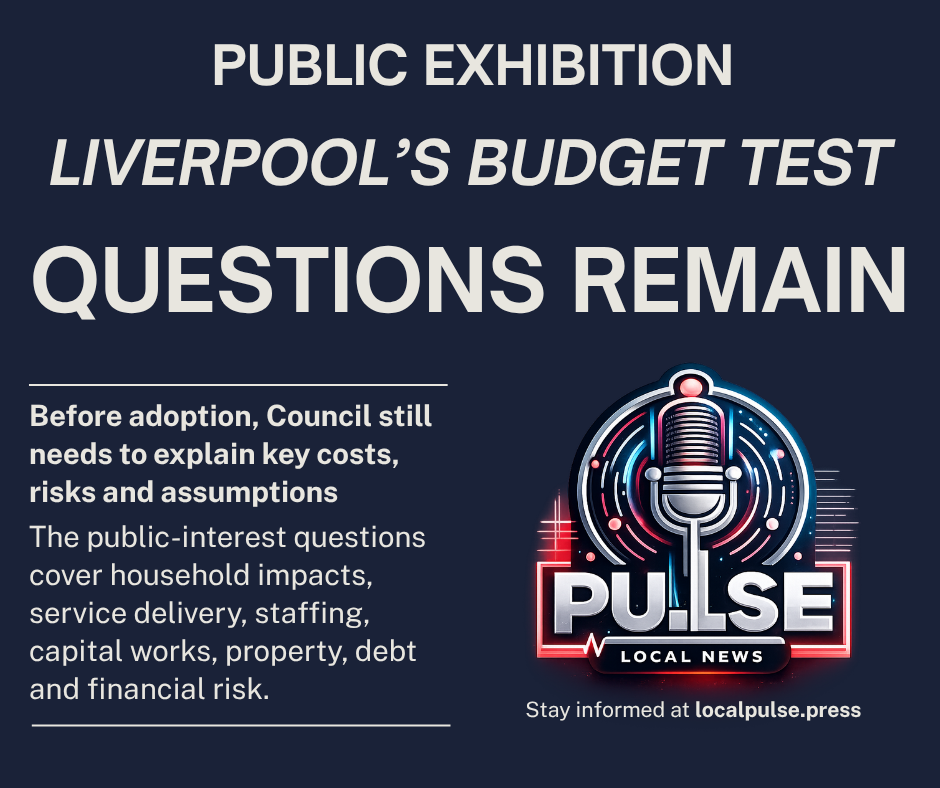

Liverpool Council’s draft budget papers set out higher household charges, extra waste-service capacity, major capital works, staffing assumptions and long-term financial risks. Before the final vote, residents should be able to see what sits behind the numbers.
Liverpool Council’s draft 2026-27 budget package is on public exhibition, giving residents a chance to respond before the final documents are adopted.
The exhibition materials include the Draft Delivery Program 2025-2029, Draft Operational Plan 2026-2027, Long-Term Financial Plan 2027-2036, Draft Revenue Pricing Policy (Fees and Charges), and Liverpool Rating Category Map.
The public exhibition materials give residents the broad settings, but several details still need clearer explanation before adoption.
The draft budget sets out what residents may pay, which services may improve, which projects may proceed, and what risks remain.
What is the full household impact?
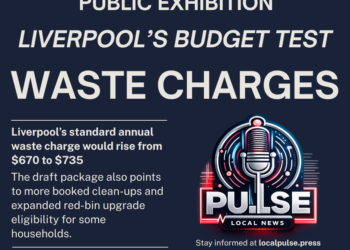
The draft documents point to a 4.1% increase in Council’s 2026-27 rates income and an increase in the standard annual Domestic Waste Management charge from $670 to $735.
The $65 waste increase is explained through contractor pricing, CPI adjustment, increased household clean-up service and red-bin upgrades.
Residents may also be affected by changes to fees and charges, depending on the services they use.
Council should provide a plain-English household impact summary showing how the proposed rates settings, standard annual waste charge and common fees fit together.
A useful summary would separate ordinary rates, the standard annual Domestic Waste Management charge, statutory fees, discretionary fees and user-pays charges.
Residents should not have to piece that answer together across multiple documents.
Can the waste uplift be delivered within the two-week service standard?
The exhibited documents point to four booked household clean-ups per year and expanded red-bin upgrade eligibility as key waste-service changes.
Council’s 18 May report referred to current bulk household collection lead times of four to six weeks. The exhibited Draft Operational Plan refers to four booked household clean-ups per year with a maximum two-week service agreement.
The basic booked clean-up process already exists. The budget question is whether the expanded entitlement can be delivered reliably within the proposed two-week standard.
Council should explain whether the budgeted resourcing is enough if uptake is higher than modelled, and how residents will be able to see whether the service has improved.
What service improvements will residents actually notice?
The draft budget package points to service changes and service reviews across several visible areas of Council work.
Residents should be told which services are expected to improve in 2026-27, what the current baseline is, and how improvement will be measured.
Examples include roads, footpaths, parks, mowing, waste, illegal dumping, parking, compliance, customer requests and local maintenance.
Council should explain what will be faster, cleaner, easier or more reliable.
How will the planned service reviews be reported?
The draft Delivery Program identifies service-review work across areas such as customer service, illegal waste, regulatory compliance and property services.
Those reviews need clear public reporting: what is being reviewed, what baseline is being used, and what changes are made.
Council should explain whether the outcomes of those reviews will be published separately, reported through quarterly updates, or only folded into annual reporting.
Residents should also be told whether the reviews will include clear service standards and public-facing measures.
Are the staffing assumptions realistic?
The 18 May budget report discusses employee cost assumptions, staged recruitment, existing vacancies and the filling of Operations Directorate roles.
Service delivery depends on staffing.
Council should explain which roles are being filled, what service areas are affected, and what happens if recruitment takes longer than expected.
The Long-Term Financial Plan also relies on later-year efficiency assumptions, including the gradual implementation of Council’s One Source / TechnologyOne system and other technology advances such as AI.
Council should explain how much of the plan depends on those efficiencies being delivered, and what would happen if the expected savings or productivity gains do not arrive on time.
Which capital works are fully funded, and which are only early-stage?
The draft budget package includes a large capital works program across roads, bridges, footpaths, drainage, floodplain works, parks, recreation, land and buildings.
For residents, the useful detail is what is happening in their suburb, whether a project is funded for design or delivery, whether it depends on grants or developer contributions, and when work is expected to begin.
Council should provide a clearer project-by-project explanation of the capital works program, especially for visible local infrastructure.
That would show which works are likely to be delivered in 2026-27 and which sit further down the pipeline.
What assumptions carry the biggest financial risk?
The Long-Term Financial Plan includes base-case modelling and a pessimistic scenario.
Council should identify the assumptions most likely to affect the plan if conditions change. Those may include income, costs, staff recruitment, service uptake, capital project costs, grants, investment returns, property income and broader economic conditions.
Residents need to know which assumptions matter most, how much room there is for error, and what Council would do if those assumptions do not hold.
What role do Civic Place and Council properties play in the plan?
Council’s long-term financial material refers to debt, property income and asset optimisation.
Council should explain how major Council-owned or Council-managed properties fit into the financial plan.
This includes the role of Liverpool Civic Place, commercial property income, loan servicing, asset optimisation and any assumptions about better use of Council property.
Council should also explain whether any property disposals are assumed in the Long-Term Financial Plan, or whether they are only listed as possible future mitigation.
If rental income or asset optimisation supports the financial outlook, residents should be able to see the assumptions behind it.
How will public submissions be dealt with?
Council should explain how submissions will be reported, whether themes will be summarised publicly, and whether any changes are made before adoption.
Residents should be able to see whether public feedback changes anything.
Not every submission will be accepted, but the final report should show what the community raised, how Council considered it, and why the final position was adopted.
The accountability test
The draft planning and financial papers contain the broad settings. Before adoption, residents need the missing details.
What will households pay? What service improvements will they see? What projects are actually funded? What assumptions carry risk? What will be measured? What will change if residents raise concerns during the exhibition?
These questions go to whether residents can understand the cost, service and risk trade-offs before the final vote.
Have your say
The draft budget package remains on public exhibition until 15 June 2026.
Residents can read the documents and make a submission through Liverpool Council’s Public Exhibitions and Notices page.
Source: Liverpool City Council Public Exhibitions and Notices page; Draft Delivery Program 2025-2029; Draft Operational Plan 2026-2027; Long-Term Financial Plan 2027-2036; Draft Revenue Pricing Policy (Fees and Charges); Liverpool Rating Category Map; and 18 May 2026 CORP 05 addendum report.