


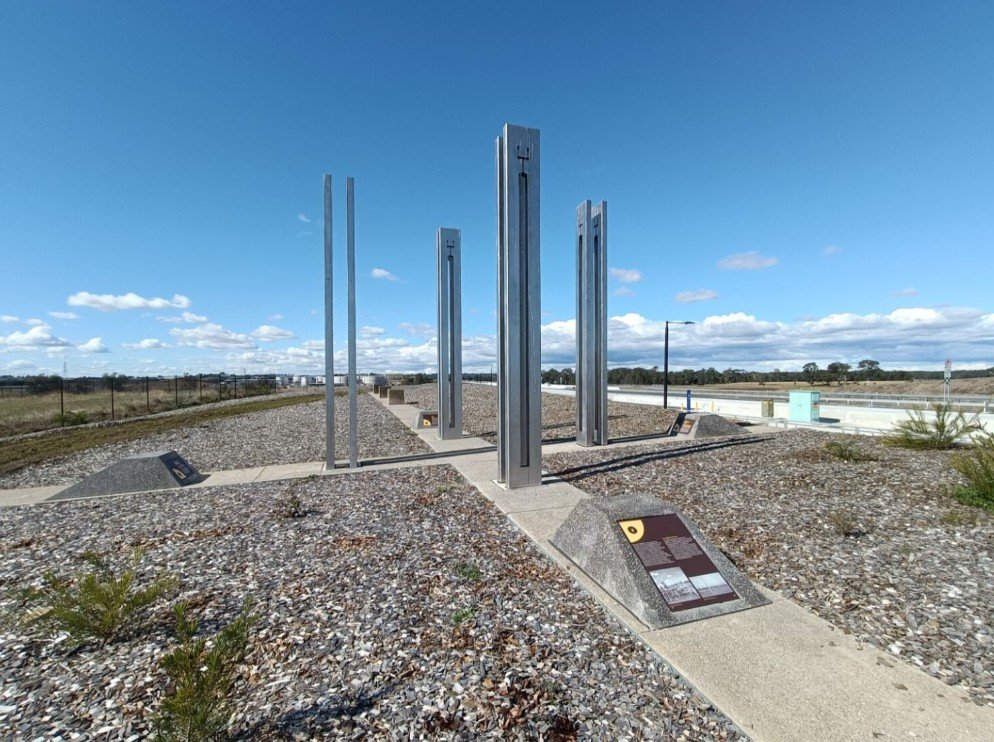

Sydney, 30 December 2025 – As the toll-free M12 Motorway gears up for its grand opening early next year, a striking new monument along its route is turning heads and paying homage to the rich history of the Badgerys Creek area. The Fleurs Monument, located near the Warami Drive interchange, stands as a powerful tribute to the region’s deep connection to the skies—from ancient Aboriginal astronomy to groundbreaking radio telescope research that helped shape modern technology.
A Nod to Sky Country and Indigenous Heritage
For millennia, the land now traversed by the M12 Motorway has been tied to “Sky Country” stories of the local First Nations peoples. One such story, the Great Emu in the Sky, is drawn from the dark patches of the Milky Way, forming the shape of the native bird. This cultural significance is beautifully captured in a 30-metre-high Emu’s nest sculpture at the airport interchange, a collaborative creation by artists and Indigenous groups, welcoming all to Dharug Country.
The sculpture, built locally, tells the Dharug Dreaming story of Mariong, the Emu Mother, who shakes water from her feathers to create the stars before becoming the Milky Way itself. Alongside this, the motorway’s design reflects the six Aboriginal seasons through carefully selected flora that blooms year-round, ensuring a vibrant landscape for all who travel this path.
Fleurs: A Cradle of Innovation
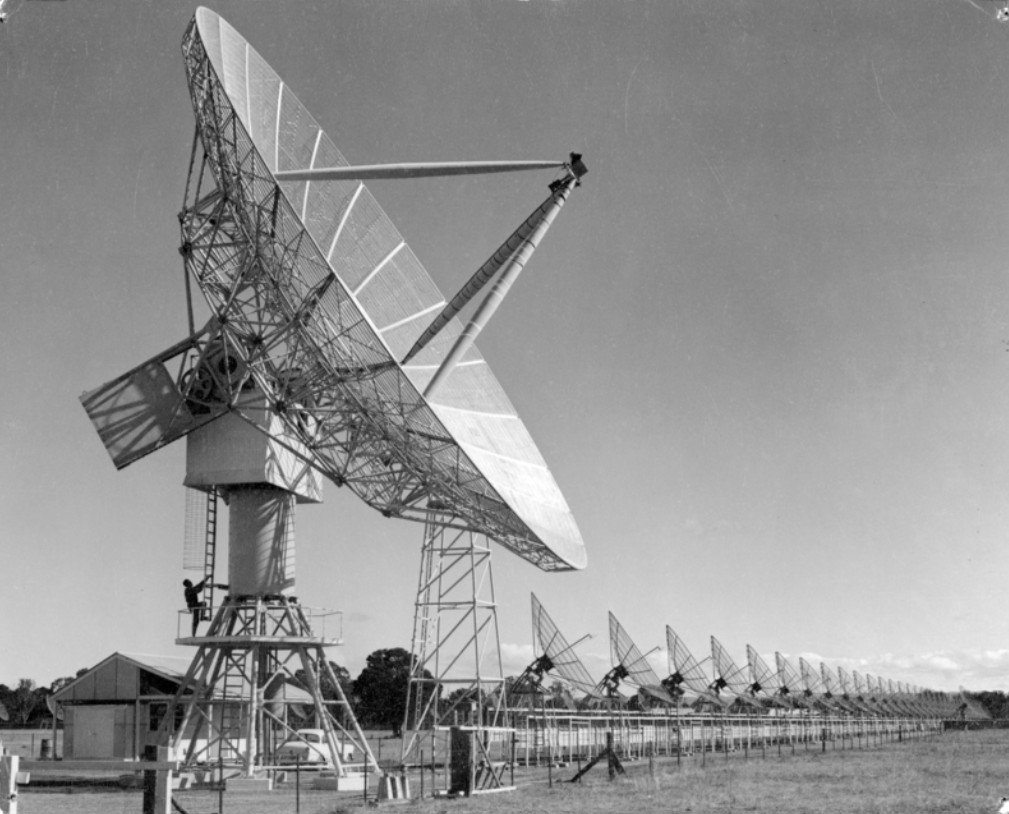
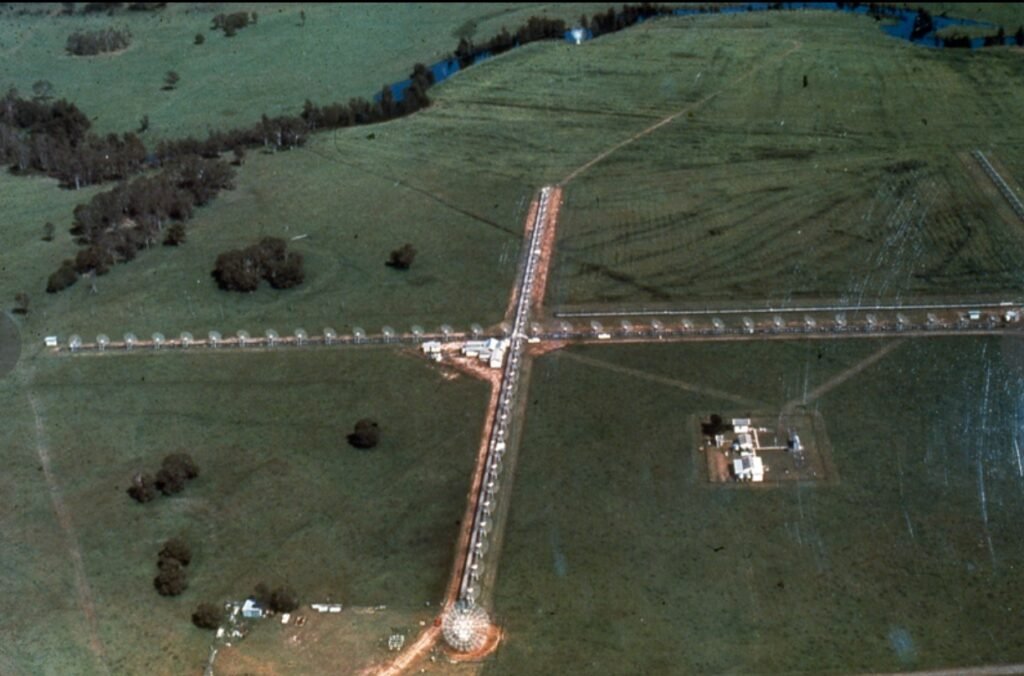
The Fleurs Monument, dubbed “The Absence of Shain Cross Poles,” also commemorates the site’s remarkable scientific legacy. Positioned next to what was once a runway for the Badgerys Creek Airport—built in 1944 during World War II—the area later became a hub for pioneering radio astronomy. From the 1950s to the 1990s, the Fleurs Radio Observatory, operated by CSIRO, the University of Sydney, and Western Sydney University, housed four innovative telescopes: the Mills Cross, Shain Cross, Chris Cross, and the Fleurs Synthesis Telescope.
These instruments were instrumental in advancing our understanding of the universe. The Mills Cross, constructed in 1954, conducted the first reliable radio survey of extragalactic sources, playing a pivotal role in confirming the Big Bang theory. By the 1970s, the Fleurs Synthesis Telescope was the most powerful of its kind in the Southern Hemisphere, listening to the stars with unmatched precision.
But the impact of Fleurs extends beyond the cosmos. As Dr John O’Sullivan, a retired CSIRO scientist who worked at Fleurs, recounts in a recent interview, the research conducted here laid the groundwork for one of the world’s most transformative technologies—Wi-Fi. “Radio astronomy at Fleurs gave us challenges and problems to solve,” Dr O’Sullivan said. “Many of us went on to make a mark in industries like telecommunications and IT. A team of Fleurs alumni later developed technology that became the IEEE 802.11a standard, which we now know as Wi-Fi.”
Voices of the Past, Echoes of Innovation
The monument itself, designed by Studio Colin Polworth with assistance from GHD and ASPECT Studios, incorporates footings from the original telescopes and overlooks the historic array site. Its blade arrangement mimics the cardinal layout of the Shain Cross poles, with silhouettes embedded in the structure, while a circular disk at its centre symbolises the planetary data once gathered here.
Dr John Reynolds, Director of ATNF Operations at CSIRO, expressed his admiration for the tribute during a recent visit to the site. “I’m really impressed with what Transport for NSW has done here,” he said. “Old instruments outlive their usefulness and need to be retired, but this is a great tribute to the minds who drove the early days of radio astronomy. Fleurs was an innovation hub, cementing Australia’s place as a world leader in the field at the time.”
Dr Tasso Tzioumis, another Fleurs alum and retired CSIRO scientist, shared a bittersweet reflection on the site’s transformation. “It’s amazing to think I did part of my PhD here, working in both engineering and astronomy,” he recalled. “It’s where I got into this field, spending the last 40 years in it. It’s bittersweet to see it gone—before the highway came through—but these memorials ensure we don’t forget. Australia pioneered so much here, and it shows we can aim high and have a go.”
Dr Tzioumis also reminisced about the hands-on nature of the work, adjusting telescopes manually every hour and even sharing personal anecdotes, like his city-raised wife’s amazement at seeing pigs up close during a visit to the site. “Australia might be a small country, but we’ve always punched above our weight,” he added with pride.
A Gateway to Sydney’s Future
The $2.1 billion M12 Motorway, a 16-kilometre east-west connection from Elizabeth Drive at the M7 interchange to The Northern Road, is jointly funded by the Australian and NSW Governments. Set to open ahead of the Western Sydney International Airport in 2026, it promises to be a vital piece of infrastructure for the region. With shared user paths for pedestrians and cyclists, rest areas under eucalypt canopies, and historical displays dotted along the route, the motorway is more than just a road—it’s a gateway into Sydney’s past and future.
Josh Murray, Secretary of Transport for NSW, emphasised the project’s broader vision. “We often talk about ‘placemaking’ in government, and this is what it looks like in practice,” he said. “The M12 is critical infrastructure, but it’s also designed with community in mind—shared paths, seasonal flora, and nods to our past like the Fleurs Monument.”
A Legacy Worth Remembering
As the M12 Motorway prepares to welcome drivers, the Fleurs Monument stands as a reminder of the ingenuity and spirit of discovery that once thrived in this corner of Western Sydney. From the ancient stories of the Great Emu in the Sky to the telescopes that mapped the universe and birthed Wi-Fi, this stretch of land has always reached for the stars. Now, with a toll-free road and a fitting tribute, it invites us all to look back—and forward—with wonder.