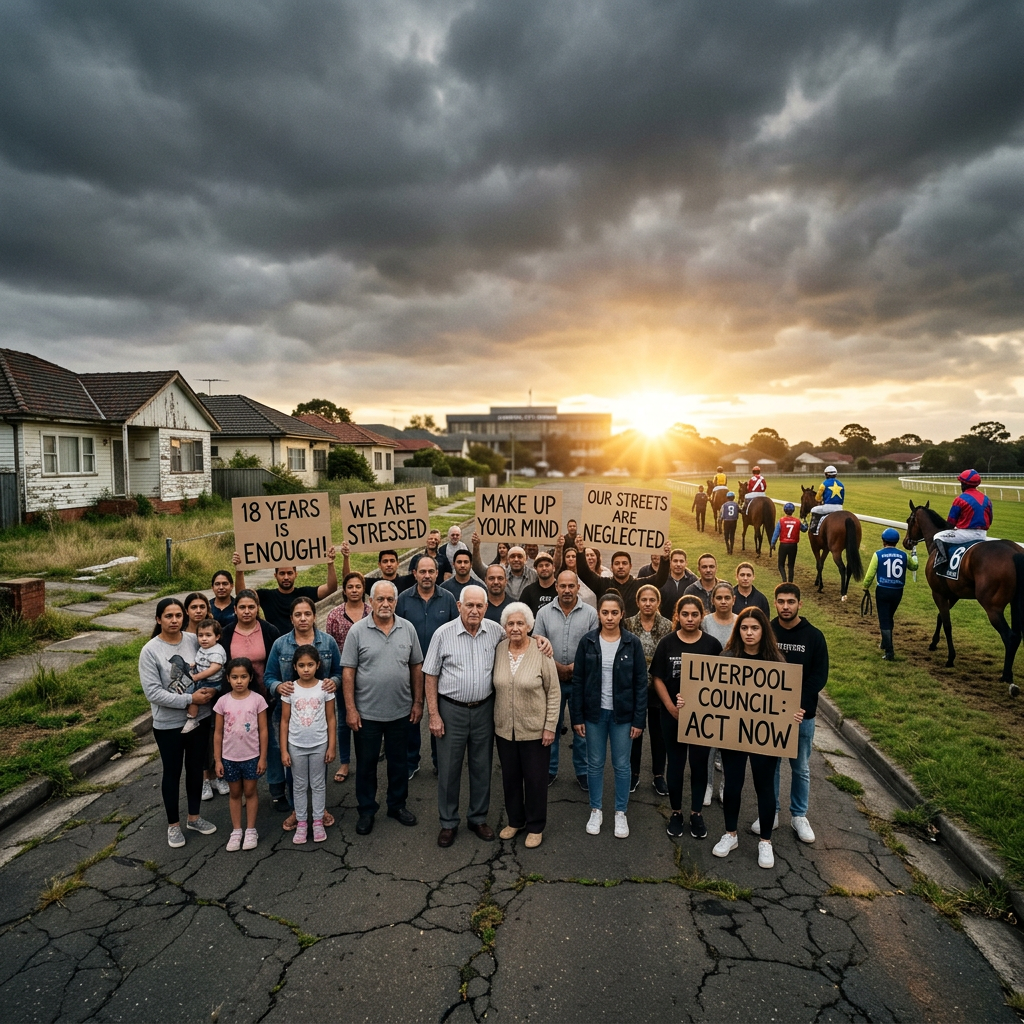
The future of one of Liverpool’s most strategically placed — and most complicated — precincts is back under the spotlight, with Liverpool City Council asked to consider the next steps for Warwick Farm amid mounting questions over flood risk, land use and the area’s long-term economic value. But for the people who actually live and own property there, the polite language of council reports masks a far uglier reality: nearly two decades of indecision, broken commitments and mounting financial hardship.
At first glance, the Warwick Farm Racing Precinct looks like a site with enormous promise. It sits beside major transport links, near Liverpool’s city centre and inside one of the fastest-growing parts of Sydney. But for years, the land has been shadowed by a harder truth: much of the precinct is constrained by flood risk, making any discussion about housing, industry or large-scale redevelopment far more difficult than it might appear on a map.
What is harder to excuse is that council has had ample opportunity to act — and repeatedly has not.
For residents, the debate is no longer abstract. It is personal, financially devastating, and it has been going on for nearly two decades.
Local precinct resident Mario Pilati addressed councillors directly at the meeting, delivering one of the more pointed public forum contributions of the night. He did not mince words.
Mario Pilati Addresses Liverpool City Council. Source:YouTube
“The stress that the residents of the precinct have been under over the last 18 years has really reached its limit. What we would like is a decision from the councillors.”
Mr Pilati told the chamber that the timeline presented in the council report contained significant omissions. He pointed to 2008, when temporary stable accommodation was built at the racecourse to house trainers displaced from Rosehill during the Pope’s visit to Sydney. What was built as temporary had quietly become permanent — with serious consequences for landowners in the precinct who have been left holding land they cannot develop, cannot sell at fair value, and cannot afford to simply sit on.
“Over a third of the land previously used for off-course horse racing is now sitting empty. I myself am part of that. My land tax per annum is $20,073 — just to give you an idea of the cost of being empty.”
That is not a minor inconvenience. That is more than $20,000 a year, every year, on land that generates nothing — land whose potential has been frozen by a planning process that has moved at a glacial pace while the bills keep arriving. Multiply that across multiple affected landowners over nearly two decades, and the financial toll on this community becomes staggering.
Mr Pilati also raised a 2014 council decision — NOM 05, file number 034386 — in which councillors committed to building a bypass road at Warwick Farm to separate industrial traffic from the racing precinct, with funds set aside from that year’s budget. That was eleven years ago. The road has never been built. The commitment has never been honoured.
“That was councillors’ decision, 14 years ago. Nothing has happened. We are still stressed out. We still have the safety problems with industrial trucks turning the corner — 36-wheelers coming around that corner, probably 200 a day.”
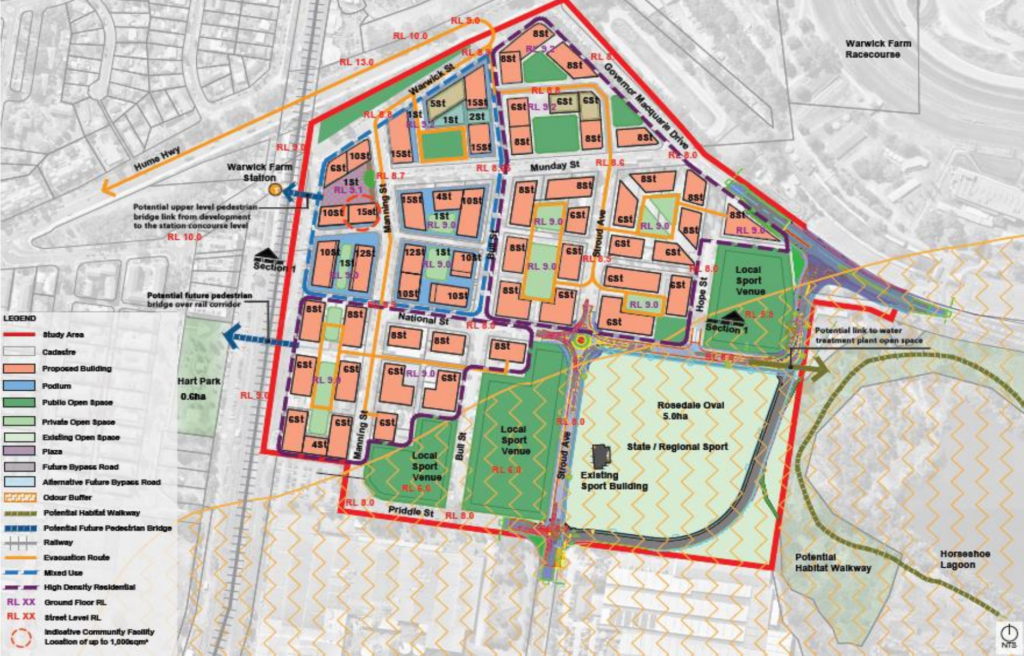
Revised Warwick Farm Structure Plan from Public Exhibition Fact Sheet in 2021 Source: Liverpool City Council
Significantly, the bypass road resurfaced as a live issue during the meeting itself. Deputy Mayor Peter Harle — who declared a non-pecuniary interest because family members live in the area but remained in the chamber at the request of constituents — confirmed during questioning of Mr Pilati that the bypass road should be strongly considered as part of any solution going forward. That an elected official is now publicly backing an infrastructure commitment that was first made in 2014 speaks volumes about how little progress has been made in the intervening years.
On flooding — often cited as the central obstacle to any redevelopment — Mr Pilati pushed back firmly on the framing, arguing the risk has been consistently overstated. He told councillors that when a lake in the area was opened to the river in the late 1980s, the land became tidal, fundamentally changing the flood dynamic.
“The maximum duration of any flood would be 12 hours. And two properties on Monday Street — one of which is mine — are not affected by the 100-year flood, so they do have egress. It doesn’t stop the SES getting to them.”
It is the kind of ground-level knowledge that tends to get lost when planning debates are conducted entirely between government agencies, consultants and council officers — while the people who actually live with the consequences are left waiting for reports that take 20 months to arrive.
Mr Pilati closed with a direct appeal to councillors, warning them not to let funding delays become the next excuse for inaction. He noted that additional funding for further reports had been requested after the July 2024 council meeting — and that 20 months had elapsed before the matter returned to the table.
“We don’t want another 20 months to go by simply asking for more funding, causing even more delay. The long, very long-suffering residents of the precinct need this to end.”
It is a reasonable ask. It is also, given Liverpool Council’s track record on this issue, far from guaranteed.
The broader challenge for council is that the usual development playbook may not apply here. Flood risk has repeatedly emerged as a defining factor, and state-level responses following the NSW Flood Inquiry 2022 have added further complexity to the planning picture. But complexity is not the same as impossibility — and it does not explain why a bypass road funded in 2014 has never been built, why temporary infrastructure from 2008 has been allowed to permanently reshape the precinct, or why landowners are still paying tens of thousands of dollars a year on land that council’s own indecision has rendered unviable.
If Liverpool is serious about its future as a genuine western Sydney city — not just a corridor people pass through on the way to the Aerotropolis — then Warwick Farm is exactly the kind of site that demands decisive action. The residents who have waited 18 years deserve nothing less.
For Mario Pilati and his neighbours, the chamber has finally heard their voices. Council has been put on notice — publicly, on the record, and in no uncertain terms. After 18 years of broken promises, stalled reports and mounting financial pain, the residents of Warwick Farm now wait for a final outcome with eager anticipation. Whether Liverpool City Council will rise to the moment, or once again find reasons to delay, remains to be seen. But one thing is certain: the community’s patience has run out, and this time, they are watching.